 Dansday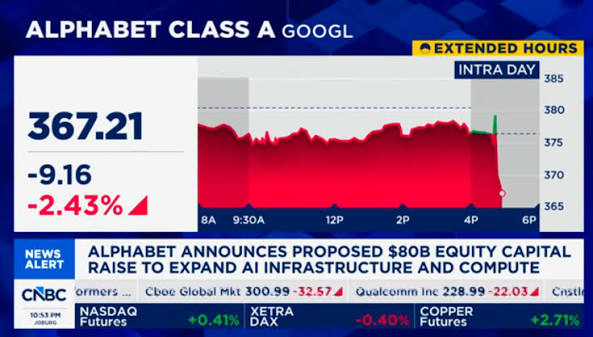
Alphabet is doubling down on the artificial intelligence race with plans to raise $80 billion to accelerate its AI infrastructure expansion.
The funding push highlights how competition in artificial intelligence is shifting from simply building better models toward controlling the massive computing infrastructure required to operate them. Alphabet, Google's parent company, is investing heavily in data centers, advanced chips, and cloud capacity to support the growing demand for AI services.
The expansion comes as major technology companies continue spending billions on AI infrastructure. Training and running large AI models requires enormous amounts of computing power, electricity, and specialized hardware. Companies with access to large-scale infrastructure have a significant advantage in developing and deploying AI products.
Google has been competing aggressively in this space through its Gemini AI models, Google Cloud platform, and custom AI hardware. The company's investment strategy reflects a belief that future AI services will depend as much on physical infrastructure as on software innovation.
The move also demonstrates the changing economics of the technology industry. In previous years, software companies could scale primarily through digital products. However, modern AI requires expensive data centers filled with powerful processors, creating a new era where capital investment and hardware capacity are critical competitive advantages.
For businesses, larger AI infrastructure investments could lead to more powerful AI services becoming available through cloud platforms. Companies may gain access to improved AI models for automation, analytics, customer support, and software development.
However, the rapid expansion of AI infrastructure also raises challenges. Data centers require significant energy consumption, specialized hardware supply chains, and large amounts of capital. Technology companies must balance innovation speed with operational costs and environmental concerns.
Alphabet's funding plans show that the AI race is becoming an infrastructure race. While companies continue competing to create smarter AI models, the winners may ultimately be determined by who can build and operate the largest, most efficient computing systems.
As artificial intelligence becomes a core technology across industries, investments like Alphabet's $80 billion expansion demonstrate that the next phase of AI development will be built on a foundation of chips, servers, and global data centers.