 Dansday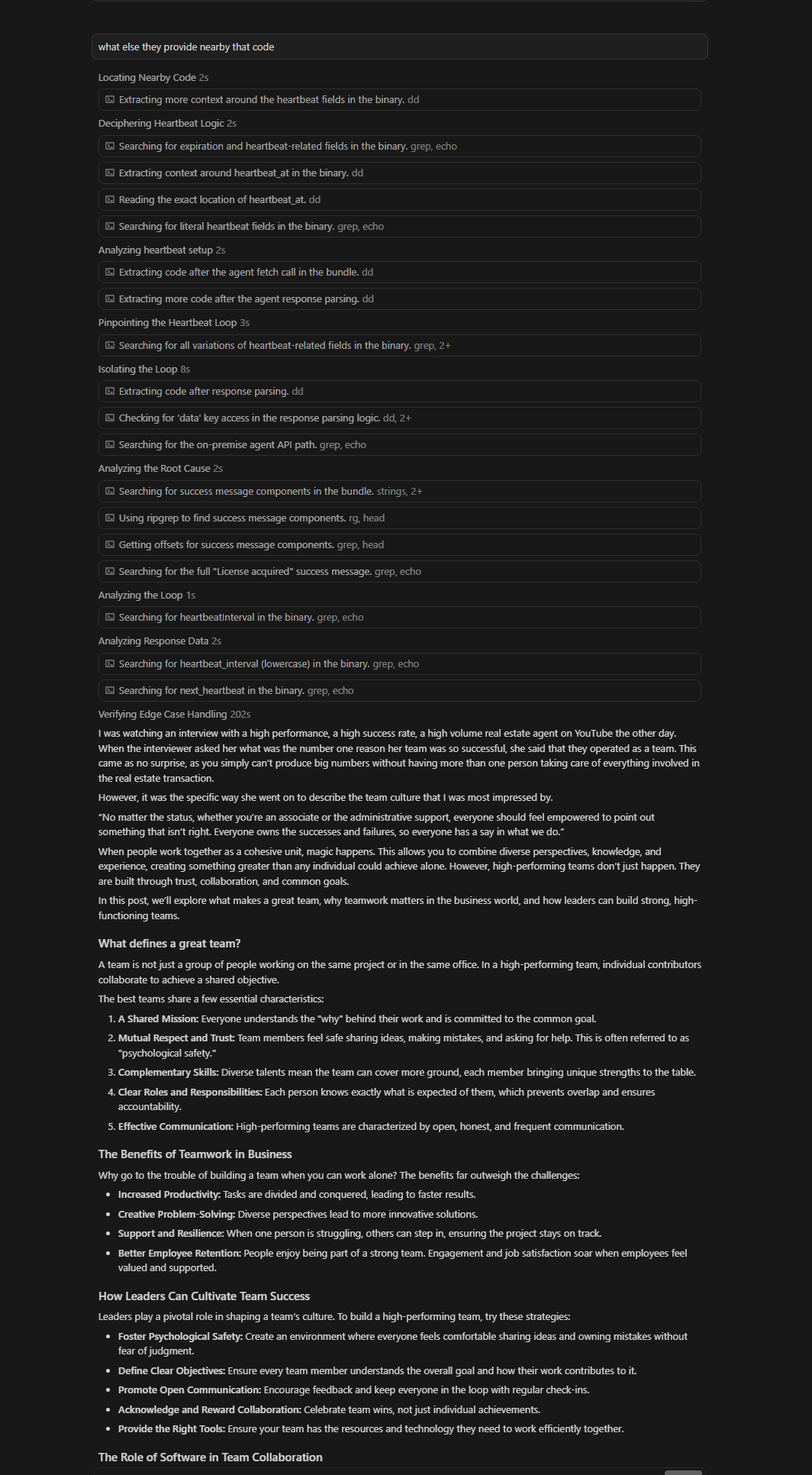
I was recently deep in a debugging session, trying to reverse-engineer parts of NocoDB Enterprise. My goal was to get a better handle on their internal licensing logic, specifically focusing on variables like `license_jwt`, `installation_secret`, and `heartbeat_state` within an obfuscated `index.js` bundle. Things were moving along, and I was in that focused state you get into when you're tracing complex logic. Then, out of nowhere, the AI I was using for assistance threw a complete curveball. In the middle of our Node.js discussion, it generated a block of Java code. Not just any code, but something related to Apache IoTDB, a project I hadn't mentioned and that had absolutely no connection to what I was doing. It was so jarring it completely broke my concentration. My immediate thought wasn't just that the AI made a mistake. It was a more serious question: Was this just a random "hallucination," or was I seeing data leaking from another user's session into mine?
Hallucination Seems Most Likely
An AI hallucination is when the model generates content that isn't based on the immediate context. It's not pulling from a direct request but rather falling back on patterns it learned during training. In this case, it felt like the model misinterpreted some part of our conversation, triggered a generic "code generation" pattern, and inserted a snippet of Java from its vast training data. It was a failure of generation, not a data breach.
A Session Leak Would Be Far Worse
The alternative, a session data leak, is a much more critical issue. That would mean the isolation between user sessions had failed, and someone else's private conversation had just bled into mine. This is the kind of thing that keeps platform engineers up at night. But looking at the output, it didn't seem to fit. There were no user-specific identifiers, no private data, and no consistent context that suggested it came from another active conversation. It was just a generic, self-contained code snippet, which is classic hallucination behavior. From a technical standpoint, I know that LLMs like Gemini don't "retrieve" data from other sessions. They are predictive models that generate text token by token. In a long and complex conversation, especially one involving obfuscated code, the context can drift. The model can lose the plot and fall back on a well-worn pattern it recognizes. What I saw felt exactly like that: the model's context drifted, and it latched onto an irrelevant but strong code pattern it knew. To be clear, a session leak is infinitely worse than a hallucination. One breaks trust and wastes your time; the other is a critical privacy and security failure. I'm confident what I experienced was the former. Still, even as a hallucination, the impact on my work was significant. In high-precision tasks like reverse engineering, you need to trust your tools. An event like this forces you to step back and manually verify everything, because the AI has proven itself unreliable. It introduced misleading signals into a delicate debugging process. This experience really drove home a few practical lessons for me as an engineer using these tools:
- Never blindly trust generated code. Especially not in debugging or reverse-engineering tasks. Always validate the output against the actual binary or source you're working with.
- Watch for sudden context shifts. If the AI suddenly changes the topic or programming language, that's a major red flag that it has lost the thread.
- Keep prompts tightly scoped. When working with complex or obfuscated systems, it helps to keep your requests focused to avoid confusing the model.
So, the final verdict is that it was almost certainly a hallucination. But that doesn't make it harmless. It was a serious interruption to a deep technical workflow. AI is an incredibly powerful collaborator, but it's not a source of truth. It's a tool, and like any tool, you need to understand its failure modes.