 Dansday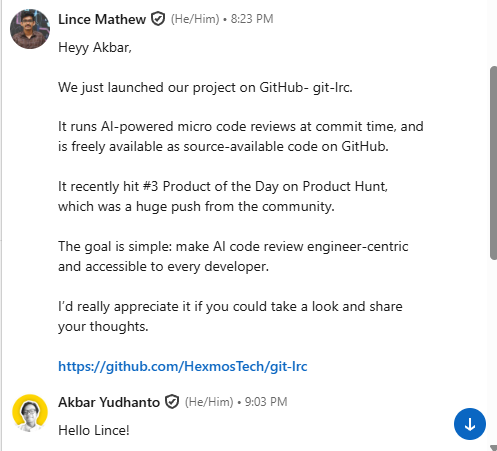
I frequently get messages from developers asking me to take a look at their new open-source projects. Sometimes it is a library, other times a CLI tool, or a platform utility. I have always believed that if I have the time, looking under the hood of what other builders are working on is one of the best ways to keep learning. It is not just about giving feedback; it is about seeing how someone else approaches a problem I might encounter myself.
Recently, I received a message about a project called git-lrc, which focuses on running AI-powered micro code reviews at commit time. It reached a solid milestone on Product Hunt, and the team reached out to see if I had any thoughts. This is exactly the kind of workflow-centric tool that catches my attention. It targets a specific pain point—getting feedback on code before it even leaves the local environment—and tries to streamline it for the developer.
When I evaluate these kinds of projects, I am not looking for perfection. I am looking for three specific things that tell me if a tool has legs:
-
1. Does it solve a genuine friction point?
I do not care about fancy marketing or over-engineered features. I care about whether the tool solves a real problem. If a tool requires more setup time than the manual effort it is trying to replace, it fails. Code reviews are often the biggest bottleneck in development; if a tool can provide meaningful insights at commit time, it has clear value.
-
2. Is the developer experience (DX) prioritized?
How easy is it to install? How does it behave in my terminal? If I have to spend thirty minutes configuring environment variables or debugging dependency conflicts before I can run a simple test, I lose interest quickly. Good open-source tools respect my time.
-
3. Is it extensible?
I look at the source code, not just the documentation. If the project is rigid, it will die as soon as the user's requirements change. If I can see where the hooks are, where I can configure the AI prompts, or where I can pipe output elsewhere, I am far more likely to stick with it.
My inbox is always open to anyone building interesting tools. If you are working on something that solves a developer problem, do not hesitate to reach out on LinkedIn. I cannot promise I will get to everything immediately, but I do appreciate the effort of builders who are trying to make the daily grind a little bit better.