 Dansday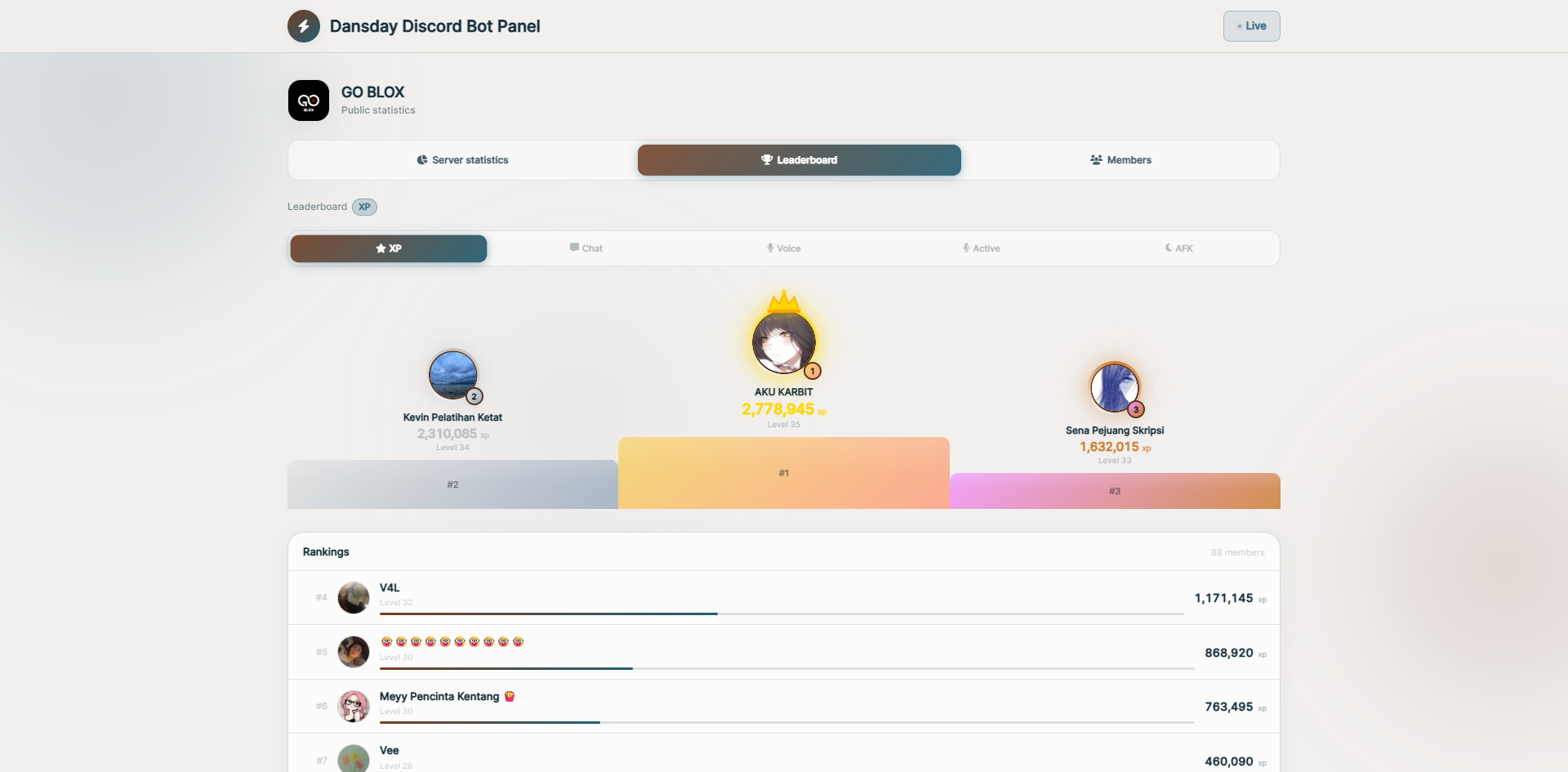
I have spent the last development cycle taking my standalone goblox bot projects and completely re-architecting them into a multi-tenant Software as a Service. What started as individual instances has evolved into an open-source platform built on SvelteKit 5 and Drizzle ORM. Moving to a multi-tenant structure was a necessary shift. Managing single bots for single servers simply does not scale, so I built a centralized superadmin panel to handle the entire fleet.
The architecture is entirely modular now. Instead of hardcoding features for every Discord community, the platform acts as a command center. A single panel can manage multiple bots, and each bot can be mapped to specific Discord servers. Everything down to the member account level and individual bot features is isolated and configurable. I designed the bot capabilities as independent components. This means server owners can flip a toggle in the dashboard to enable or disable specific functionalities based on what their community actually needs.
To make the management experience practical for server owners and staff members, I built out a comprehensive suite of tools inside the panel:
- Overview Dashboard
A high-level view showing real-time server statistics, member counts, channel metrics, and active voice session data. - Selfbot and Account Management
Dedicated interfaces to manage selfbot accounts, alongside an owner and staff management system that handles role-based access, invite links, and automated registration to the panel. - Feature Configuration Engine
The core interface where everything is customized. This handles permissions, welcomers, server boosters, channel notifications, message forwarders, levelling systems, custom supporter roles, giveaways, AFK statuses, user feedback, moderation tools, staff ratings, content creator integrations, and Discord quests. - Visual Embed Builders
A built-in editor for crafting custom bot messages and rich announcements directly from the browser without needing to write JSON. - Member Directory
A complete breakdown of server members, integrating their Discord profile information and platform activity directly into the dashboard.
One of the features I am most proud of is the public statistics page. I wanted the server activity to feel alive, leaning into a real-time competitive feel. Instead of relying on heavy WebSocket connections or delayed API polling, I implemented Server-Sent Events to stream live updates to the frontend. Whenever someone levels up or server statistics shift, the public leaderboard updates instantly for everyone watching.
Because explaining a SaaS is never as effective as letting developers touch it, I built a demo mode into the platform. Anyone can access the panel and explore the feature set without needing to create an account or authenticate. You can also join my Discord server to see exactly how the bots operate in production and interact with the interface firsthand. I have made the entire project open-source on my GitHub for anyone looking to study the multi-tenant architecture, self-host their own instance, or contribute to the codebase.